Legal documents are full of Latin terms that can feel confusing at first glance. One abbreviation that often stops readers in their tracks is “et seq.” You may have seen it in court cases, statutes, contracts, or legal articles and wondered what it actually means — and why lawyers use it so often.
In this comprehensive guide, you’ll learn what et seq means in law, where it comes from, how and when it’s used, real-world examples, comparisons with similar legal terms, alternatives, common mistakes, and answers to frequently asked questions. By the end, you’ll be able to read and use this term with confidence.
Definition
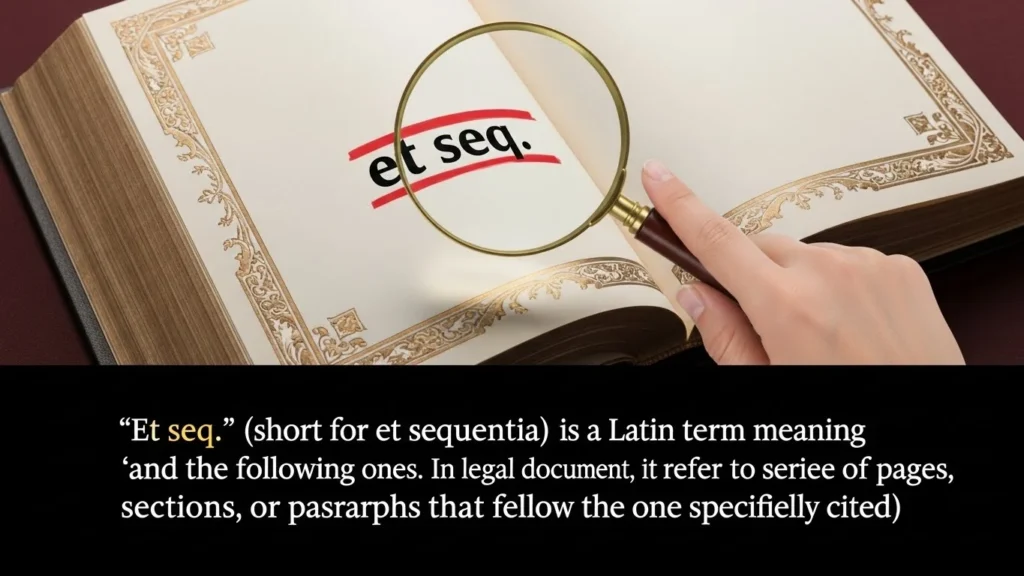
Et seq. is a legal abbreviation meaning “and the following.”
In law, it is used to refer to a statute, regulation, or legal section along with all the sections that come after it in sequence.
Why Et Seq Is Important in Legal Writing
Legal texts aim to be precise yet concise. Instead of listing multiple sections one by one, lawyers use et seq. to:
- Save space
- Avoid repetition
- Reference an entire group of related laws
- Maintain clarity and efficiency
Understanding this term helps you interpret laws, court opinions, and contracts accurately.
What Does Et Seq Mean in Law?
The phrase et seq. comes from Latin and translates to “and the following things” or simply “and the following.”
In legal usage, it signals that a reference includes not just one section, but also all subsequent sections related to the same topic.
Simple Explanation
If a law cites:
Title 15, Section 78a et seq.
It means:
- Section 78a
- Plus all the sections that follow it in that legal series
Origin and History of Et Seq
Latin Roots
Over time, “sequentia” was shortened to seq., creating the abbreviation et seq.
Why Latin Is Used in Law
- Law evolved from Roman legal systems
- Latin ensured consistency across regions
- Many legal principles were first recorded in Latin
Even today, Latin terms remain standard in legal language.
Why Et Seq Is Still Common Today
Despite modern plain-language movements, et seq. remains popular because:
- Courts recognize it universally
- Statutes are often long and detailed
- It avoids listing dozens of sections
- Legal professionals understand it instantly
It’s a shortcut that keeps legal writing precise.
How Et Seq Is Used in Legal Documents
Et seq. is most commonly used when citing statutes, regulations, or codes.
Typical Format
Law or Code Name
Section Number et seq.
Labeled Example Table: How Et Seq Is Used
| Citation ExampleWhat It Means | |
|---|---|
| Section 1983 et seq. | Section 1983 and all related following sections |
| Title VII et seq. | Title VII and subsequent provisions |
| 42 U.S.C. § 12101 et seq. | Entire statutory framework starting at that section |
Real-World Examples of Et Seq in Law
Neutral Legal Example
The complaint alleges violations of the Fair Labor Standards Act, 29 U.S.C. § 201 et seq.
This means the claim is based on the entire Act, not just one section.
Formal Court Opinion Example
The statute was enacted pursuant to Title 42 et seq. to ensure compliance with federal standards.
Used commonly in judicial opinions.
Academic or Informational Example
Consumer protection laws, including Section 5 et seq., regulate unfair business practices.
Often seen in legal textbooks and articles.
Tone and Meaning: Is Et Seq Formal?
Yes. Et seq. is strictly formal and legal.
Tone Characteristics
- Professional
- Neutral
- Academic
- Legal-specific
It is not used in casual writing or everyday conversation.
Common Legal Contexts Where Et Seq Appears
You’ll often see et seq. in:
- Statutory citations
- Court filings
- Judicial opinions
- Legal contracts
- Law review articles
- Government regulations
It signals that a series of related laws applies.
Et Seq vs Similar Legal Terms
Understanding similar abbreviations prevents confusion.
Et Seq vs Et Al
| Term | Meaning | Usage |
|---|---|---|
| Et seq. | And the following | Laws and statutes |
| Et al. | And others | People or parties |
Et Seq vs Passim
- Et seq.: Continuous following sections
- Passim: Scattered references throughout a document
Et Seq vs “Including but Not Limited To”
- Et seq. refers to specific sequential sections
- “Including but not limited to” is broader and less precise
Alternate Meanings of Et Seq
In legal contexts, et seq. has only one meaning.
Outside law, it is rarely used and may confuse readers.
Plain-English Alternatives to Et Seq
In non-legal writing, clearer alternatives may be better.
Alternatives
- And the following sections
- And related provisions
- And subsequent sections
- And related laws
These are often preferred for public-facing documents.
Common Mistakes When Using Et Seq
- Using it when only one section applies
- Confusing it with et al.
- Using it in informal writing
- Applying it to people instead of laws
- Misplacing punctuation
Correct usage matters for legal accuracy.
Conclusion:
Et seq. is a small but powerful legal abbreviation. It signals that a reference includes more than just one section, helping legal writers stay concise and precise.
Frequently Asked Questions
What does et seq mean in law?
It means “and the following” and refers to subsequent legal sections.
Is et seq always italicized?
Often yes in formal legal writing, but style guides vary.
Can et seq be used in contracts?
Yes, but plain-English alternatives are sometimes preferred.
Does et seq include all sections after it?
Yes, until the logical end of that statute or topic.
Is et seq used outside law?
Rarely, and usually only in academic contexts.
What is the difference between et seq and et al?
Et seq refers to laws; et al refers to people.
Can I replace et seq with plain English?
Yes, especially for non-lawyers.
Is et seq required in legal citations?
No, but it is commonly used for efficiency and clarity.

My name is Ava Mitchell. I work on TextSOrbit.com, where I create informative, well-researched, and SEO friendly content. I focus on writing clear and engaging articles that help readers understand topics easily while improving search visibility