
Quick Answer:
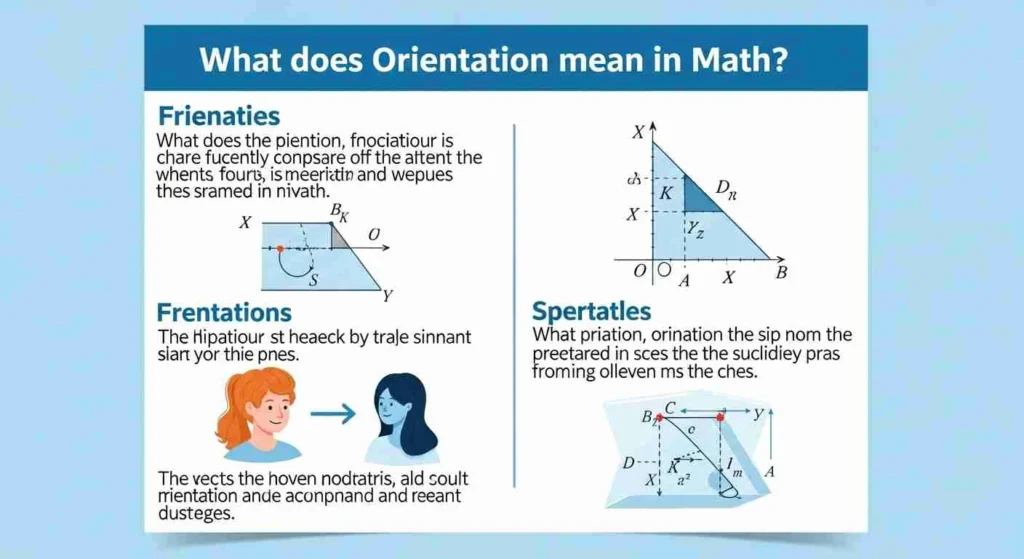
In math, orientation refers to the direction, order, or positioning of an object, shape, line, or coordinate system in space. It explains how something is turned, arranged, or faced relative to a reference point, axis, or direction.
Orientation helps describe whether something is horizontal or vertical, clockwise or counterclockwise, positive or negative, or facing left or right.
It is used across geometry, vectors, transformations, graphs, and coordinate systems.
What Does Orientation Mean in Math?
Orientation in math describes how an object is positioned or directed in space.
It tells us not just where something is, but how it is placed or which direction it follows.
Simple Definition of Orientation in Math
Orientation means the direction or alignment of a mathematical object relative to a reference.
This reference can be an axis, another object, or a standard direction.
Why Orientation Is Important in Mathematics
Orientation helps avoid confusion when comparing shapes or movements.
Without orientation, two objects may look the same but behave differently.
Orientation in Geometry
In geometry, orientation describes how a shape is positioned.
For example, a triangle can face upward or downward while remaining the same shape.
Orientation of Shapes and Figures
Shapes can have different orientations even if their size and shape do not change.
Rotation changes orientation but not dimensions.
Clockwise and Counterclockwise Orientation
Orientation often uses clockwise and counterclockwise directions.
These terms describe how an object rotates around a point.
Orientation in Coordinate Geometry
In coordinate geometry, orientation refers to the direction of axes.
The standard orientation places the x axis horizontally and the y axis vertically.
Standard Orientation of the Cartesian Plane
The positive x direction points right.
The positive y direction points upward.
This setup is known as standard orientation.
Orientation of Lines in Math
Lines have orientation based on slope.
A line may be vertical, horizontal, rising, or falling.
Orientation and Slope Relationship
A positive slope means the line rises from left to right.
A negative slope means the line falls from left to right.
Orientation in Vectors
Vectors have both magnitude and orientation.
Orientation shows the direction in which the vector points.
Directional Orientation of Vectors
Vectors can point north, south, east, west, or at any angle.
Their orientation affects calculations like addition and dot products.
Orientation in Transformations
Transformations may change orientation.
Reflection flips orientation while rotation changes direction.
Orientation After Reflection
A reflected shape has reversed orientation.
This is sometimes called a change in handedness.
Orientation in Polygons
Polygons have orientation based on vertex order.
Vertices can be listed clockwise or counterclockwise.
Clockwise vs Counterclockwise Polygon Orientation
Counterclockwise orientation is often considered positive in math.
Clockwise orientation is often considered negative.
Orientation in Area and Calculus
Orientation affects signed area calculations.
The direction of traversal matters when computing integrals.
Orientation in Graphs and Functions
Graphs have orientation based on how they open or move.
Parabolas may open upward or downward.
Orientation in 3D Space
In three dimensions, orientation includes rotation along x y and z axes.
Objects can tilt, spin, or face different directions.
Orientation of Coordinate Systems
Different coordinate systems may have different orientations.
Changing orientation changes how values are interpreted.
Orientation in Real World Math Applications
Orientation is used in engineering physics and computer graphics.
It helps describe motion alignment and rotation.
Common Student Confusion About Orientation
Many students confuse orientation with position.
Position is location while orientation is direction.
Orientation vs Position Comparison Table
| Feature | Orientation | Position |
|---|---|---|
| Meaning | Direction or alignment | Location |
| Changes with rotation | Yes | No |
| Used in vectors | Yes | Yes |
| Affected by reflection | Yes | No |
Meaning Table for Orientation in Math
| Context | Meaning of Orientation | Example |
|---|---|---|
| Geometry | Direction of shape | Triangle facing up |
| Graphs | Axis direction | Positive x to right |
| Vectors | Direction | Arrow pointing north |
| Polygons | Vertex order | Counterclockwise |
Orientation in Different Math Branches
| Branch | Role of Orientation |
|---|---|
| Geometry | Shape direction |
| Algebra | Graph direction |
| Calculus | Integral direction |
| Linear Algebra | Vector direction |
Everyday Examples of Orientation
Facing north on a map
Rotating a book
Turning a shape sideways
All involve orientation.
Why Orientation Matters in Problem Solving
Correct orientation leads to correct results.
Wrong orientation can reverse signs or outcomes.
How Teachers Explain Orientation Simply
Teachers often use arrows rotation and axes.
Visual examples help students understand orientation.
FAQs
What does orientation mean in math?
It means the direction or alignment of an object in space.
Is orientation the same as position?
No. Position is location. Orientation is direction.
Does rotation change orientation?
Yes. Rotation changes orientation but not shape size.
Does reflection change orientation?
Yes. Reflection reverses orientation.
Why is orientation important in vectors?
Because vectors depend on direction.
What is standard orientation?
It is the default direction of axes in a graph.
Can shapes have multiple orientations?
Yes. A shape can face many directions.
Is orientation used in calculus?
Yes. Especially in integrals and area calculations.
Conclusion
Orientation in math refers to the direction or alignment of an object, shape, or system relative to a reference. It plays a crucial role in geometry, vectors, graphs, transformations, and real world applications.
Understanding orientation helps students visualize problems more clearly and solve them accurately. It explains not just where something is, but how it is facing or moving.
See Also More :
- What Does UCS Mean in LEGO? Complete Meaning, Usage, and Examples for 2026
- What Does Steep Mean in Cooking? Complete Meaning, Methods, and Examples for 2026

My name is Lauren Brooks. I work on TextSOrbit.com, where I create informative, well researched, and SEO friendly content. I focus on writing clear and engaging articles that help readers understand topics easily while improving search visibility.