
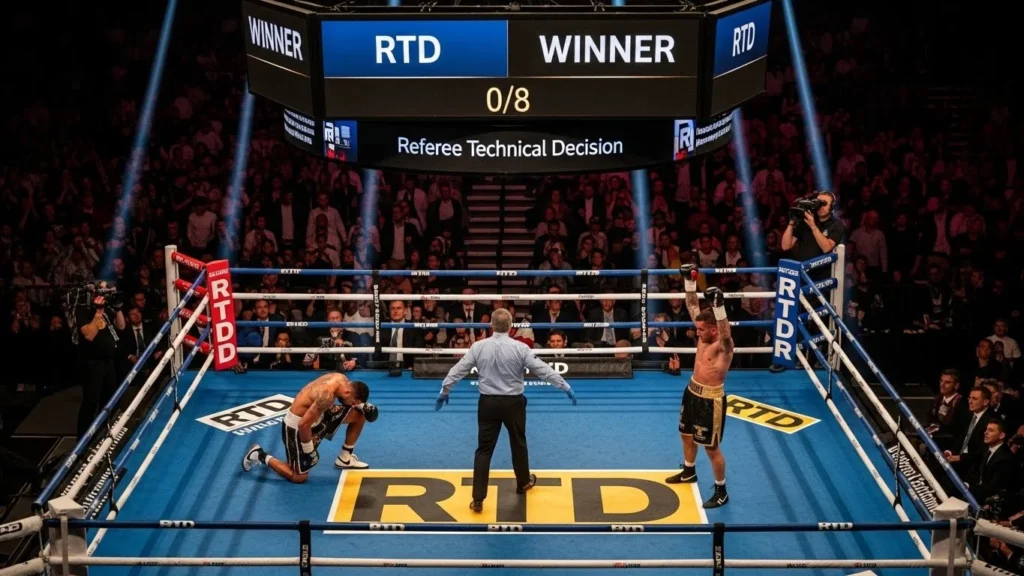
If you’ve ever watched a boxing match, followed fight results online, or checked a fighter’s record, you may have seen the result RTD and wondered what it actually means. Unlike knockouts or decisions, RTD is less common and often misunderstood, yet it plays an important role in professional and amateur boxing.
In this in-depth guide, we’ll break down what RTD means in boxing, how it differs from other fight outcomes, why it happens, and how it affects fighters’ records. You’ll also find real-world examples, comparisons with similar terms, FAQs, and practical insights—all explained in a clear, friendly, and professional way.
Definition
RTD in boxing means “Retired.”
It indicates that a boxer did not continue the fight because they or their corner decided not to answer the bell for the next round, resulting in a loss by retirement.
Why RTD Matters in Boxing
RTD isn’t just a technical label—it reflects important decisions about:
- Fighter safety
- Strategy and long-term career health
- Corner responsibility
- Fight dynamics
Understanding RTD helps fans better interpret fight results and appreciate the behind-the-scenes decisions that shape a bout.
What Does RTD Mean in Boxing?
RTD stands for Retired, meaning a boxer voluntarily stops fighting between rounds. This usually happens when:
- The fighter is injured
- The boxer is exhausted
- The corner decides it’s unsafe to continue
Unlike a knockout, the fight does not end during a round. Instead, the boxer fails to come out when the next round begins.
Origin and History of RTD in Boxing
Where the Term Comes From
- Used in boxing records for decades
- Adopted officially by sanctioning bodies
- Common in professional and amateur bouts
RTD became standardized to clearly distinguish between in-round stoppages and between-round decisions.
Why RTD Is Still Common Today
- Fighter safety
- Medical evaluation
- Smart corner decisions
Modern boxing recognizes that not every fight needs to end in a dramatic knockout to be decisive.
How an RTD Happens During a Fight
An RTD typically follows this sequence:
- A round ends
- The boxer returns to the corner
- The fighter or corner assesses condition
- Decision is made not to continue
- Referee declares RTD
The opposing boxer is awarded the victory.
Labeled Example Table: RTD vs Other Fight Endings
| Result Type | When Fight Ends | Who Stops It | Key Difference |
|---|---|---|---|
| KO | During round | Referee | Boxer is knocked out |
| TKO | During round | Referee/Doctor | Fight stopped for safety |
| RTD | Between rounds | Boxer or corner | Fighter does not continue |
| Decision | After final round | Judges | Fight goes full distance |
Real-World Examples of RTD in Boxing
Injury-Based RTD 🤕
A boxer suffers a severe eye swelling by Round 6. After medical advice, the corner stops the fight before Round 7. Result: RTD (7).
Strategic RTD 🧠
A young fighter is taking heavy punishment against a champion. The corner retires him to protect his long-term career. Result: RTD (9).
Exhaustion-Based RTD 😮💨
A boxer is physically spent and unable to defend effectively. The trainer stops the fight between rounds. Result: RTD (10).
Tone and Meaning of RTD
RTD is neutral and professional. It does not imply weakness or quitting in a negative sense.
Important Context
- Often viewed as a smart safety decision
- Reflects responsibility from the corner
- Common in high-level competition
In boxing culture, protecting a fighter’s health is respected.
RTD vs Similar Boxing Terms
| Term | Meaning | Key Difference |
|---|---|---|
| RTD | Retired | Fight stopped between rounds |
| TKO | Technical Knockout | Fight stopped during a round |
RTD vs KO
- KO: Boxer is knocked unconscious
- RTD: Boxer is conscious but unable or advised not to continue
RTD vs No Contest
- RTD: Clear winner declared
- No Contest: Fight stopped due to external issues
Does RTD Count as a Loss?
Yes. An RTD is recorded as a loss for the retiring boxer and a win for the opponent.
Record Impact
- Counts the same as a TKO loss
- Appears in official fight records
- Can affect rankings and future matchups
Alternate Meanings of RTD
Outside boxing, RTD can mean:
- Ready to Drink (beverages)
- Resistance Temperature Detector (engineering)
Why Corners Choose RTD
Corners may choose retirement to:
- Prevent serious injury
- Avoid permanent damage
- Save a fighter for future bouts
- Follow medical advice
Common Misconceptions About RTD
- RTD is not quitting mid-round
- RTD is not disqualification
- RTD is not always injury-related
- RTD is not viewed as cowardice
Usage Tips for Boxing Fans and Writers
- Always note the round number with RTD
- Use RTD instead of TKO when accurate
- Explain it clearly for casual audiences
Conclusion:
RTD may not be as dramatic as a knockout, but it’s one of the most responsible outcomes in boxing. It represents a decision rooted in safety, strategy, and long-term thinking.
Frequently Asked Questions
What does RTD stand for in boxing?
RTD stands for Retired.
Who decides an RTD?
The boxer or their corner makes the decision.
Does RTD count as a knockout?
No, but it counts as a stoppage loss.
Can a champion lose by RTD?
Yes, titles can change hands via RTD.
Why do trainers stop fights by RTD?
To protect a fighter’s health and safety.
Is RTD considered controversial?
Usually no it’s widely accepted and respected.

My name is James Anderson. I work on TextSOrbit.com, where I create informative, well researched, and SEO friendly content. I focus on writing clear and engaging articles that help readers understand topics easily while improving search visibilit.