
If you have ever watched legal dramas read court news or studied basic law you may have heard the word tort. It sounds formal and confusing at first which makes many people ask what does tort mean in law and how it affects everyday life.
This complete and easy to understand guide explains the meaning of tort in law in a clear friendly and professional way. You will learn its definition origin real world usage types examples comparisons and practical understanding so you can grasp the concept without legal confusion.
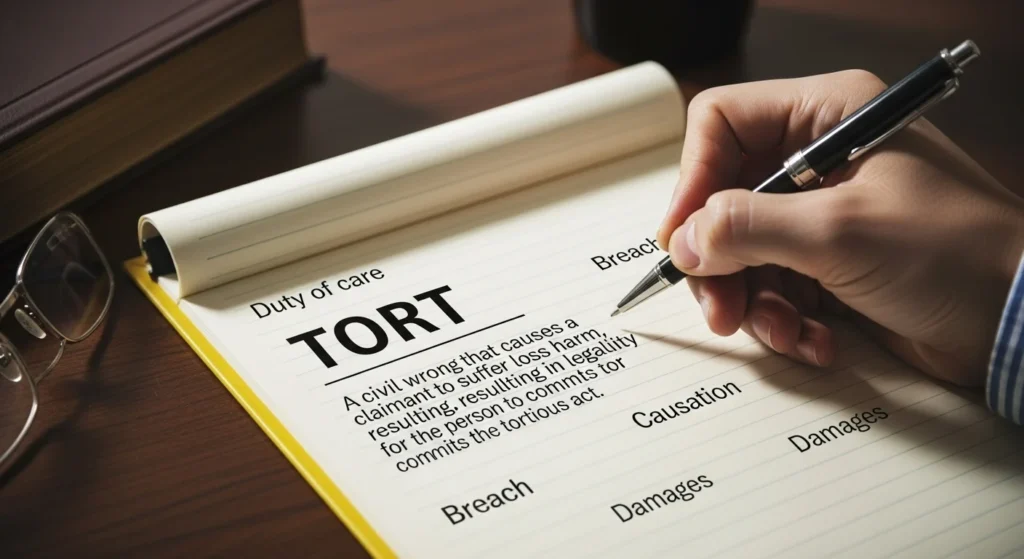
A tort in law means a civil wrong that causes harm or loss to another person and leads to legal liability.
In simple words a tort happens when someone hurts another person or their property and the law allows the injured person to seek compensation.
What Does Tort Mean in Law
A tort is not a crime and it is not a contract dispute. It is a civil matter where one person claims that another person caused harm through actions or failure to act responsibly.
The goal of tort law is to
- Compensate the injured person
- Hold people accountable for harm
- Prevent future harmful behavior
Tort law focuses on fairness and responsibility rather than punishment.
Origin of the Word Tort
The word tort comes from an old language meaning wrong or twisted. Over time legal systems adopted the term to describe wrongful acts that harm others.
As societies developed rules for personal rights and safety tort law became a way to resolve disputes peacefully instead of personal revenge.
Today it is a major part of modern legal systems around the world.
Why Tort Law Is Important
Tort law protects individuals and property by setting standards of behavior.
It helps ensure that
- People act responsibly
- Victims receive compensation
- Businesses follow safety rules
- Harmful actions have consequences
Without it many everyday disputes would have no clear resolution.
Common Types of Torts in Law
Torts are generally grouped into three main categories.
Intentional Torts
Intentional torts happen when someone deliberately causes harm.
Common Examples
- Assault
- Battery
- False imprisonment
- Defamation
- Trespassing
These involve purposeful actions that violate another persons rights.
Negligence Torts
Negligence occurs when someone fails to act with reasonable care and causes harm.
Examples of Negligence
- Car accidents caused by careless driving
- Medical malpractice
- Slip and fall accidents
- Unsafe property conditions
Negligence is the most common type of tort in daily life.
Strict Liability Torts
Strict liability applies even if there was no intent or carelessness.
Examples
- Defective products
- Dangerous animal ownership
- Hazardous activities
In these cases responsibility exists regardless of fault.
Labeled Example Table of Tort Types
| Tort Type | Description | Example |
|---|---|---|
| Intentional | Deliberate harm | Physical assault |
| Negligence | Lack of care | Traffic accident |
| Strict liability | Automatic responsibility | Faulty product |
Real World Examples of Tort Law
Everyday Example
A driver causes an accident by texting while driving
This is a negligence tort.
Business Example
A company sells a dangerous product
This may fall under strict liability.
Personal Example
Someone spreads false statements damaging a reputation
This is defamation which is an intentional tort.
These examples show how it applies to daily life.
What Tort Law Is Not
Understanding it also means knowing what it does not cover.
- It is not criminal law
- It does not involve jail time
- It is not about breaking contracts
- It focuses on compensation not punishment
Criminal cases involve the government while tort cases involve private individuals.
Tort Law Versus Criminal Law
Many people confuse it with criminal law.
Comparison Table
| Tort Law | Criminal Law |
|---|---|
| Civil cases | Criminal cases |
| Compensation focused | Punishment focused |
| Private lawsuits | Government prosecution |
| Money damages | Fines or prison |
The same act can sometimes be both a tort and a crime.
Remedies in Tort Law
The main remedy in it is compensation.
Common Remedies
- Monetary damages
- Medical expense coverage
- Property repair costs
- Compensation for pain and suffering
The aim is to restore the injured person as much as possible.
Who Can Be Sued in a Tort Case
Anyone who causes harm may be sued including
- Individuals
- Businesses
- Professionals
- Organizations
It applies broadly to protect public rights.
Burden of Proof in Tort Cases
In tort law the injured person must prove
- A duty existed
- The duty was breached
- Harm occurred
- The breach caused the harm
This standard is lower than in criminal law.
Alternate Meanings of Tort
Outside of law the word tort has no common alternate meaning. It is mainly a legal term.
In everyday language it is rarely used unless discussing legal matters.
Professional Alternatives to the Word Tort
In simple conversation people may say
- Civil wrong
- Legal injury
- Personal injury claim
These phrases explain the idea without legal jargon.
Why Tort Law Affects Everyone
Even if you never go to court it impacts daily life by
- Encouraging safe behavior
- Protecting consumers
- Promoting responsibility
- Offering legal solutions
From driving to shopping it plays a role.
Common Misunderstandings About Tort Law
- Thinking torts are crimes
- Believing only lawyers deal with torts
- Assuming all lawsuits are tort cases
- Thinking intent is always required
Clear understanding removes unnecessary fear.
FAQs
What does tort mean in law
A tort means a civil wrong that causes harm and leads to legal liability.
Is a tort a crime
No a tort is a civil matter not a criminal offense.
What is the most common tort
Negligence is the most common type of tort.
Can a business commit a tort
Yes businesses can be liable for torts.
What is the goal of tort law
The goal is compensation and accountability.
Can the same act be a crime and a tort
Yes some actions can fall under both systems.
Do tort cases always go to court
No many are settled outside court.
Is compensation guaranteed in tort cases
No it depends on proof and legal findings.
Conclusion
Understanding what tort means in law helps clarify how the legal system protects people from harm by providing a fair and structured way to resolve civil disputes.
It is designed to hold individuals or organizations responsible when their actions cause injury, damage, or loss to others, focusing on restoring balance rather than imposing criminal punishment.
Knowing the basics of it empowers individuals to understand their rights and responsibilities in society.
See Also More:
- What Does F2P Mean in Games ?Monetization & Examples 2026
- What Does Eloping Mean in Autism Definition Meaning Safety 2026

My name is Lauren Brooks. I work on TextSOrbit.com, where I create informative, well researched, and SEO friendly content. I focus on writing clear and engaging articles that help readers understand topics easily while improving search visibility.